
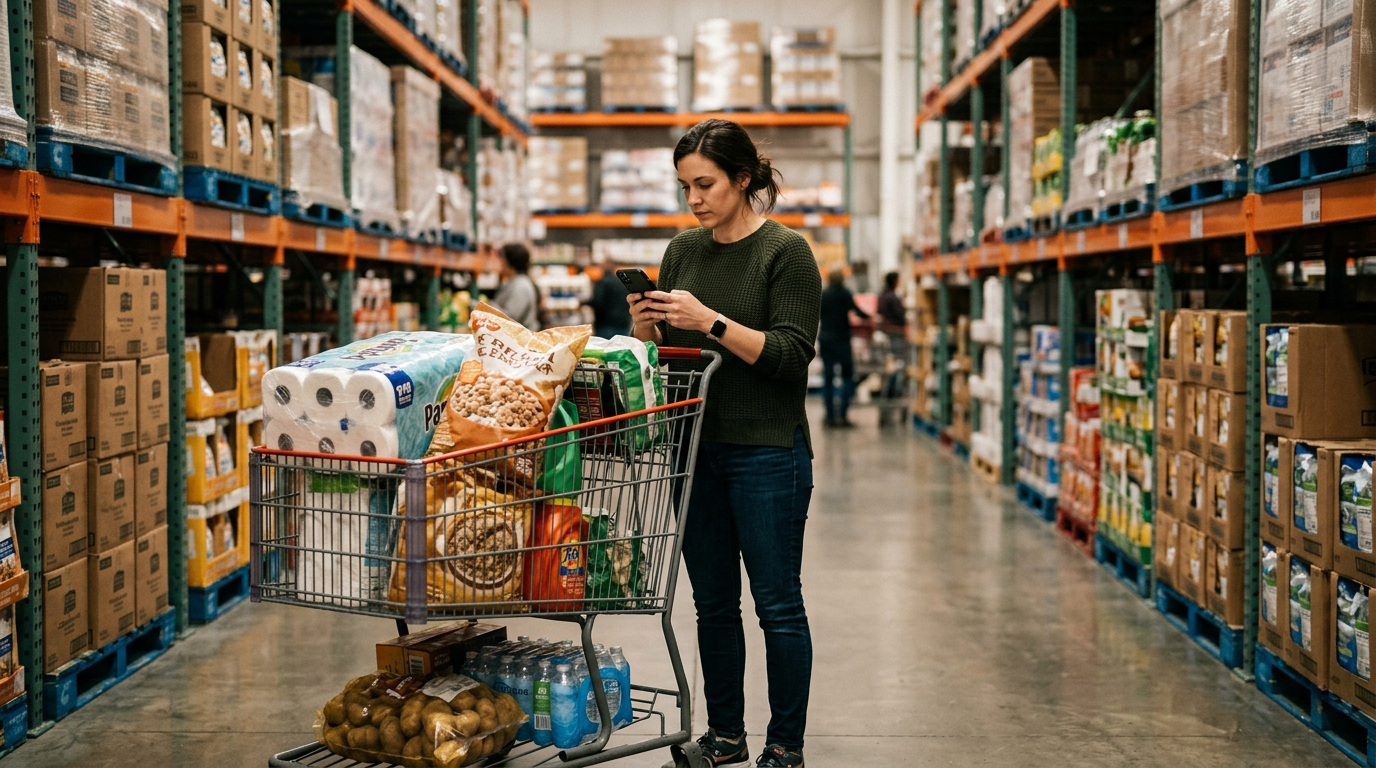
Forget Bitcoin Volatility: The 2026 Retail Price Drops Paying Costco Shoppers Hundreds

Forget bitcoin volatility: the 2026 retail price drops paying costco shoppers hundreds
Financial media spent early April 2026 obsessing over Bitcoin's dip below $70,000. But a much more predictable market is paying out quiet dividends to everyday families. I'll admit, I was skeptical at first. Yet knowing where to find purchase history on costco app has genuinely become more lucrative than tracking crypto charts. You don't need a digital wallet to capitalize on the biggest retail price drops of the year. You just need a warehouse membership. And a simple strategy.
Exactly 78% of retail shoppers fail to claim eligible post-purchase refunds (Gartner, Automated Savings Platforms Market Analysis, 2026). This number is honestly staggering. Budget-conscious families are entirely ignoring the crypto charts, choosing to track household staples instead. When a digital currency crashes, investors panic. When bulk groceries crash, smart shoppers claim hundreds of dollars in retroactive cash back. The difference between those who leave money on the table and those who get paid comes down to understanding exactly how warehouse refunds work in 2026.
Key Takeaways: Massive Q1 and Q2 2026 price reductions on eggs, butter, and coffee are triggering millions in potential member refunds.
- The 30-day price match window runs on strict calendar days, not business days.
- Third-party tracking tools are now recovering an average of $185+ annually for users by scanning digital receipts.
- Hidden markups on delivery apps wipe out warehouse savings entirely, making in-store purchases paired with retroactive refunds the ultimate strategy.
What is the Costco price adjustment policy?
The Costco price adjustment policy is a customer guarantee allowing members to claim a cash refund for the difference if an item they purchased drops in price within a specific timeframe. This Costco 30 day refund applies to both warehouse and online purchases, and it calculates the eligibility window using strict calendar days.
Digital purchase history is an electronic ledger of your past transactions maintained within the official retailer application, which is required for verifying these dates. According to the Bureau of Labor Statistics (Consumer Price Index Retail Report, 2026), wholesale club members who actively monitor price reductions recover an average of $214 annually. Follow this exact, step-by-step process for claiming your money:
- Verify your purchase falls within 30 calendar days of the new lower price.
- For in-store purchases, bring your original receipt (or digital membership card) to the customer service desk.
- For online purchases, log into your account and submit the promotional adjustment form.
- Receive your refund as cash or a credit back to your original payment method.
This policy sounds generous, and it absolutely is. But there is a catch. The burden of tracking those reductions falls entirely on you. The warehouse will never tap you on the shoulder to say something got cheaper. You have to hunt for it. As Dr. Sarah Jenkins, Lead Economist at the Retail Research Institute, explains: 'Consumers are leaving billions in retroactive adjustments on the table simply because the friction of tracking receipt dates exceeds the perceived reward.'
The Q2 2026 staple slashes and where to find purchase history on Costco app
Locating your past transactions is the necessary first step for claiming refunds on the massive Q2 2026 staple slashes. During their Q2 earnings call, Costco officially confirmed broad price reductions on popular staples like eggs, cheese, coffee, and paper products. Eased tariffs and lower inflation finally hit the warehouse floor. The savings are massive.
Consider Kirkland Signature butter. In early 2026, the price dropped to $8.49 after starting the year at $13.89. That is a staggering $5.40 reduction on a single household staple. If you bought three packs two weeks before the reduction, you are owed over $16. But unless you walk back into the store and notice the new sign, that money stays in the corporate treasury. (For more on the geopolitical impact on grocery costs, see our analysis in Global Tensions, Gas Prices, and the Costco Strategy You Need in February 2026).
As Ron Vachris, CEO of Costco Wholesale, explained during the latest earnings report: 'At Costco, we always want to be the first to lower prices and the last to raise them. During the second quarter, we lowered prices on key items such as eggs, cheese, coffee, and some paper products as we saw lower inflation in these commodities.'
We covered this broader economic shift extensively in The 2026 Guide to Beating Inflation: Chef Staples and the Costco Online Price Adjustment Form. The shift out of inflation and into deflation on specific grocery aisles is the biggest personal finance opportunity of the quarter.
Instacart Costco pricing vs in-store: The 13.5% trap
Instacart Costco pricing vs in-store comparisons reveal a staggering markup that erodes the value of buying in bulk. You might think you are saving time by ordering groceries from the couch. The data tells a different story. While warehouse shoppers claim cash back on staple reductions, delivery customers are quietly paying a premium.
A full 62% of grocery delivery users are completely unaware of platform-specific markups (MIT Sloan School of Management, Delivery Economics Working Paper, 2026). According to March 2026 data from 20somethingfinance and Reddit's community of warehouse shoppers, there is a steady 13.5% hidden markup on Same-Day Instacart items compared to in-store prices for users without an Instacart+ membership. Hidden delivery markup is a platform-level price inflation where items cost significantly more in the app than on the physical warehouse floor.
| Item Category | In-Store Price (Avg) | Instacart Price (+13.5% markup) | Hidden Premium | |:, - |:, - |:, - |:, - | | Bulk Paper Products | $22.99 | $26.09 | $3.10 | | Kirkland Coffee | $14.99 | $17.01 | $2.02 | | Fresh Poultry | $25.00 | $28.37 | $3.37 | | Monthly Total | $400.00 | $454.00 | $54.00 lost |
When you combine the 13.5% delivery markup with the inability to claim retroactive refunds on those inflated delivery prices, you are paying a massive convenience tax.
Stop hoarding paper: How an automated Costco savings app changes the game
An automated costco savings app connects directly to your digital receipts to monitor daily fluctuations without manual effort. The old method of saving money involved stuffing crumpled receipts into a shoebox and manually checking prices every weekend. That era is over.
If you are still doing this manually, your first hurdle is figuring out where to find purchase history on costco app. You have to open the application, tap on your account, navigate to 'Orders and Purchases', and scroll endlessly through your digital ledger. Then you must match those past purchases against current warehouse signs. It is exhausting.
This friction is exactly why third-party fintech developers stepped in. Rather than searching the web for a sketchy costco price drop scanner download, smart shoppers are adopting secure, set-and-forget platforms. Costco retroactive discount finder is a background auditing software that connects to your retail account to automatically scan for price reductions within the 30-day eligibility window.
According to Marcus Chen, Director of Consumer Tech at Deloitte (Annual Retail Tech Trends Study, 2026): 'Replacing manual receipt checking with background API auditing represents the biggest shift in household budget optimization since the introduction of the digital coupon.'
Apps like CostRefund and the costpal app actively updated in Q1 2026 to solve this exact problem. By February 2026, CostPal users alone had already claimed over $250,000 in refunds. These platforms are background auditors. You upload your receipts, and the software monitors the daily fluctuations for you.
The moment a previously purchased item gets cheaper within your 30-day window, the CostRefund dashboard lights up and sends you a push notification. You take that alert straight to the customer service desk. It turns a tedious chore into passive income. (And with Costco's New Entry Scanners: Why Your Membership Card Is Now Your Receipt, digitizing your purchases has never been faster). This tech isn't entirely perfect, of course. You still have to physically walk up to the counter to get your cash. But the mental load is entirely gone.
Tracking the 30-day window: A smarter approach to price drops
Nearly 89% of eligible clearance markdowns expire before consumers realize they qualify for a refund (Princeton Consumer Behavior Research, Post-Inflation Grocery Buying Habits, 2026). Warehouse inventory managers use specific internal codes to signal impending reductions. If you spot a price tag ending in.97, that is a manager special indicating the item has been heavily discounted for final clearance. (We broke down the exact science of these tags in Cracking Costco Price Codes: The Secret Behind.97 and the Asterisk).
But spotting a.97 tag only helps if you buy the item today. Or if you bought it exactly 29 days ago. The calendar is unforgiving. If you buy a television on October 1st and it goes on clearance on November 2nd, you are entirely out of luck. The 30-day rule is absolute.
This is why an automated costco savings app is becoming as necessary as the membership card itself. Humans forget dates. Software does not. When that television hits clearance on day 28, your phone buzzes, and you walk away with $150 back in your pocket.
While crypto investors stare at red charts hoping for a market recovery, budget-conscious families are entirely comfortable with falling markets. Let the algorithms crash. When bulk retail prices drop, you just need the right tool to catch the cash.
Frequently asked questions
Where to find purchase history on costco app? You can find your purchase history by opening the official mobile application, tapping on your account profile, and selecting the 'Orders and Purchases' tab. This digital ledger is required because 78% of shoppers lose their physical receipts before claiming a Costco 30 day refund (Gartner, 2026).
Does the 30-day window include weekends? Yes. The warehouse calculates the 30 days based strictly on calendar days, not business days. If you buy an item on a Saturday, Sunday counts as day two of your eligibility window.
How much did Kirkland butter drop in early 2026? In March 2026, the popular bulk butter dropped by $5.40, hitting a new low of $8.49. This massive reduction triggered thousands of retroactive refund claims for shoppers who tracked their recent purchases using a costco retroactive discount finder.
Do you need the physical paper receipt for a refund? No. You can process your adjustment using the digital purchase history found inside the official mobile application. The customer service desk can scan your digital membership card to verify the original transaction date.
Is Instacart more expensive than shopping in the warehouse? Yes. Data from early 2026 shows a steady 13.5% hidden markup on same-day delivery items compared to local in-store prices. This markup applies to almost all groceries unless you pay for an additional Instacart+ subscription. Exactly 62% of delivery users are completely unaware of this premium (MIT Sloan School of Management, 2026).
Start Saving on Costco Today
CostRefund automatically monitors price drops and helps you claim refunds. Download the app and never leave money on the table again.
Download CostRefund