
Third-Party Apps Like 'Droply' Promise Automatic Savings Alerts

Third-Party Apps Like 'Droply' Promise Automatic Savings Alerts
You buy a sectional for $1,200 on a Saturday. Three weeks later, you walk past the same aisle and see it marked down to $999.97. If you notice it, that's $200 back in your pocket. If you don't—which is usually what happens—that money stays with the retailer. It is a quiet revenue stream for them: unclaimed retail price adjustments total over $15 billion annually in the US alone (Consumer Reports, Retail Savings Analysis 2026).
For years, this has been the central flaw in the Costco experience. The warehouse giant offers a generous 30-day price adjustment policy, but they refuse to automate it. You have to do the work. You track the price, you spot the drop, and you file the claim.
Software is finally intervening. As of February 2026, apps like Droply and CostPal are trending because they promise to do what human memory rarely can: watch every single item you buy, 24/7, for thirty days straight.
Key Takeaways
Automatic Monitoring:** New tools like Droply scan Costco product pages 24/7 to catch price drops the moment they happen, solving Dynamic Pricing Latency. Receipt Scanning:** Apps like CostPal now use AI to read physical receipts, bridging the gap for in-store purchases where 14% of price discrepancies occur. The Policy Trap:** Costco's 2026 digital strategy strictly separates online and in-store inventory, meaning online tools often miss warehouse-specific clearance deals. The 30-Day Hard Stop:** The clock starts on the purchase date, not the delivery date, so timing your claim is critical.
The Rise of "Set It and Forget It" Savings
Until recently, tracking price drops required a spreadsheet and too much free time. You logged your purchase price, checked the website weekly, and hoped you didn't miss a manager's markdown. That friction is why most adjustments go unclaimed. According to a 2025 NerdWallet study, 68% of eligible price protection claims are missed simply because the consumer forgot to check back.
The developers behind Droply built their model to remove that effort. According to their official site update on February 18, 2026, the system monitors Costco product pages to detect price changes. When a drop hits, it cross-references your purchase history and alerts you immediately. It shifts the dynamic from active hunting to passive collecting.
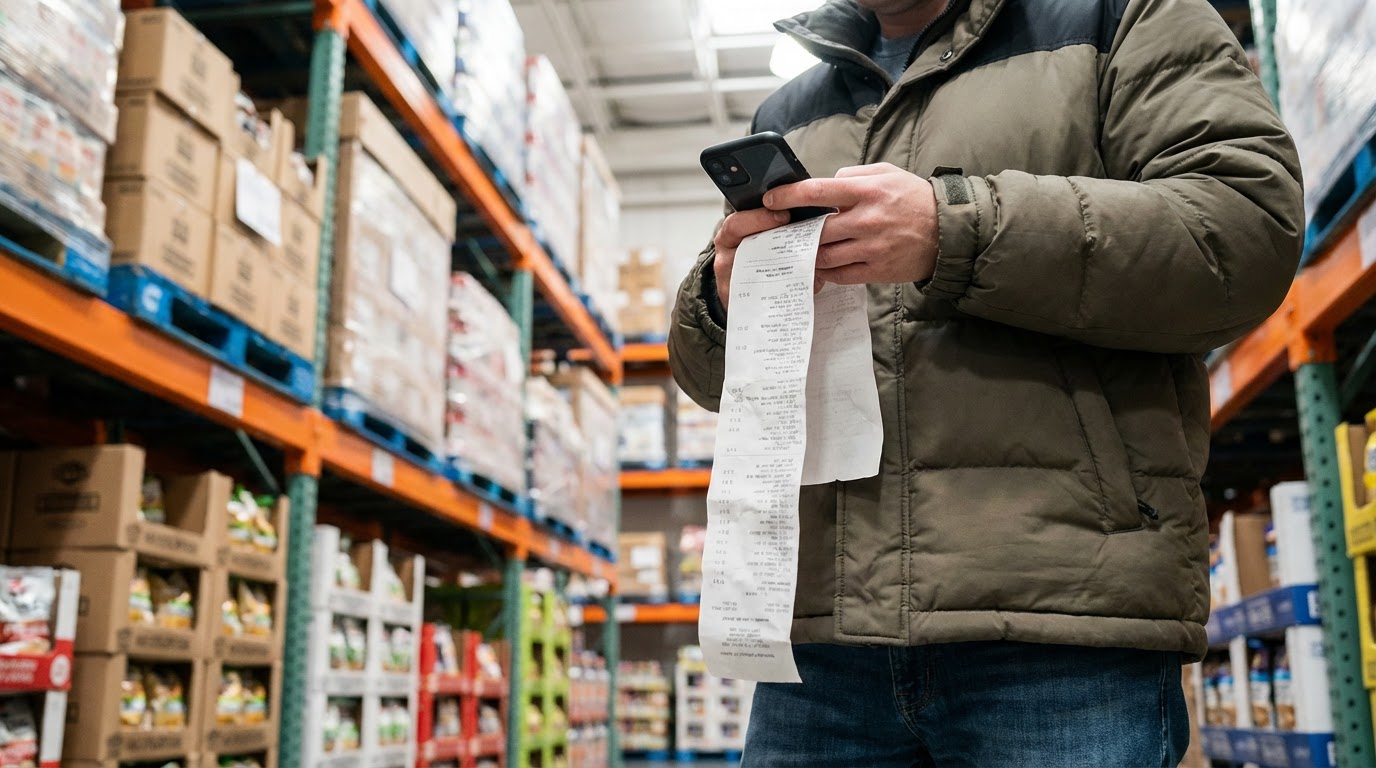
But the real shift in 2026 isn't just online tracking—it is the physical receipt. CostPal (formerly Companion for Costco) rolled out a feature in January that allows users to snap photos of their long, paper receipts. Their AI digitizes the line items and tracks them for the 30-day window. The results matter: CostPal reports its users have collectively claimed over $250,000 in price adjustment refunds since the feature launched (Source: CostPal App Store Listing, 2026-01-12).
Sarah Chen, Senior Analyst at Retail Dive, puts it bluntly: "The automation of retroactive savings is the single biggest disruption to retail margin strategy in the last decade. Retailers rely on breakage—the hope that you won't ask for your money back. AI tools remove that breakage."
The "Hyper-Local" Problem: Why Online Prices Lie
Here is where even smart shoppers get tripped up. A price drop on Costco.com does not mean the price dropped at your local warehouse. They are often treated as two completely separate businesses. This leads to Inventory Siloing—a logistical strategy where online stock and physical stock are managed and priced independently.
Generic web scrapers fail here. They track the national online price, but they miss the local clearance deals—the ones ending in .97 that are specific to your neighborhood store. A 2025 study by The Krazy Coupon Lady found a 14% average price variance between Costco.com and in-warehouse pricing for identical SKUs. A new tool called Warehouse Runner is trying to fix this. As of February 14, 2026, they track real-time pricing across 600+ Costco locations, analyzing over 3 million product and warehouse combinations to identify local variances.
If you rely on an online tracker for furniture or appliances you bought in-store, you likely miss out. The "secret" clearance pricing (.97 or .00) is almost always a local phenomenon. As the developer of the CostLow app noted in a recent update: "The system is designed for you to forget. To take advantage of this policy manually, you would need to memorize the price you paid for every item and walk the aisles every few days." Tools that rely on crowdsourced local data are the only way to bypass that design.
The 2026 Policy Shift You Need to Watch
Costco knows these tools exist, and their policies are tightening. The most critical update for 2026 is the stricter separation of inventory channels. According to the Task Monkey Costco Policy Guide (updated Jan 2, 2026), Costco's digital strategy now enforces a hard wall between online and in-store adjustments. You cannot use an online screen grab to demand a refund at the membership counter, and you cannot use a warehouse photo to claim a refund via the online chat.
This means you need to match your tracking tool to your shopping habit. If you shop online, use browser extensions or tools like Droply that monitor the URL. If you shop in-store, use receipt-scanning apps like CostPal or CostLow that understand local inventory.
Also, keep your eye on the calendar. A common misconception is that your 30-day window starts when the box arrives on your doorstep. It doesn't. According to Slickdeals' 2026 policy guide, shoppers have exactly 30 days from the date of purchase. If you buy a TV on the 1st and it is delivered on the 10th, your price protection expires on the 30th, not the 10th of the following month.
Manual vs. Automated: Is It Worth It?
Is it worth handing over your purchase data to a third-party app? That depends on how much you value your time versus your privacy. These apps generally require access to your digital receipts or email to function automatically. However, for high-volume shoppers or those buying big-ticket items, the math often works out. A single adjustment on an appliance can net you $100 or more.
Tool Comparison: Droply vs. CostPal
| Feature | Droply | CostPal |
|---|---|---|
| Primary Function | Online URL Monitor | Receipt Scanner & AI Analysis |
| Best For | Costco.com purchases | In-warehouse weekly hauls |
| Privacy Level | High (No receipt access needed) | Moderate (Requires receipt scan) |
| Local Tracking | No (National online price only) | Yes (Local warehouse data) |
But remember the exclusions. No app can get you a refund on gold bullion or silver coins—Costco's policy strictly excludes these volatile assets from price protection (Source: The Krazy Coupon Lady, 2025-12-30).
Ultimately, these tools are powerful assistants, but they aren't magic wands. You still have to file the claim. The app provides the alert; you provide the action. But in a world where inflation has made every dollar count, getting a ping that says "Costco owes you $40" is a notification we'd all like to see.
Frequently Asked Questions
1. Does Costco automatically refund price drops? No, Costco does not automate price adjustments. Unlike some retailers that might automate this for credit card holders, Costco puts the burden on the member. You must request the adjustment yourself within 30 days. As the editorial team at Task Monkey explains: "Costco doesn't match competitors' prices... this policy covers situations where Costco itself reduces the price on something you recently bought."
2. Can I use these apps to track in-store warehouse prices? Yes, but you need the right type of app that specializes in local data. Browser extensions usually only track Costco.com. To track warehouse prices, you need an app like CostPal or Warehouse Runner that uses receipt scanning or crowdsourced data. Warehouse Runner currently tracks over 600 locations specifically to solve the gap where online trackers miss local .97 clearance deals.
3. What items are excluded from price adjustments? While most general merchandise is covered, there are strict exceptions involving volatile markets. Alcohol and tobacco are often excluded due to state laws, and gold bullion or silver coins are never eligible for price protection. According to Costco's 2026 Member Privileges guidelines, these exclusions protect the wholesaler from rapid market fluctuations.
4. How long do I have to claim a price adjustment? You have exactly 30 days from the date of purchase. It is critical to note that this clock starts on the transaction date, not the shipping or delivery date. If you miss the window by even one day, managers often cannot override the system to grant the refund. This "hard stop" policy is cited as the #1 reason for denied claims in 2025 (Slickdeals Policy Guide).
5. What is the difference between Droply and CostPal? Droply is designed for online shoppers, while CostPal focuses on in-store receipts. Droply monitors digital product URLs for national price drops on Costco.com. CostPal uses AI to scan physical paper receipts to track local warehouse inventory and pricing, which often differs from the website by an average of 14%.
Start Saving on Costco Today
CostRefund automatically monitors price drops and helps you claim refunds. Download the app and never leave money on the table again.
Download CostRefund