
The Pentagon's AI War: Why the 'Supply Chain Risk' Label Matters for Your Wallet

The Pentagon's AI War: Why the 'Supply Chain Risk' Label Matters for Your Wallet
On February 18, 2026, the Department of Defense dropped a bombshell. It wasn't about a new missile or a carrier group. It was about software.
The Pentagon is currently weighing whether to designate Anthropic—the $14 billion maker of the Claude AI model—as a "supply chain risk."
If you're a Costco member or just trying to keep your grocery budget under control, your eyes might be glazing over right now. This sounds like inside-baseball tech drama. Something for the lobbyists to worry about while the rest of us get on with our lives.
It isn't.
When the U.S. government threatens to slap a domestic company with a classification usually reserved for foreign adversaries like Huawei, it sends a shockwave through the economy. This dispute isn't just about a $200 million military contract. It's about the software infrastructure that powers logistics, inventory management, and potentially the retail systems you rely on every week.
I've been tracking defense procurement for years, and usually, it's dry stuff. But this standoff is different. It matters for anyone who cares about the price of goods, supply chain stability, and the future of consumer privacy.
Key Takeaways
The Conflict:** The Pentagon may label Anthropic a "supply chain risk" after the company refused to remove ethical guardrails from its AI for military use (DoD Press Briefing, Feb 2026). The Stakes:** A "risk" designation acts like a quarantine. It could force major U.S. companies to strip Anthropic's AI from their systems. Forrester Research (2026) estimates this could impact 40% of the Fortune 500's logistics workflows. The Consumer Impact:** Tech overhauls are expensive. When retailers face higher operational costs, those costs almost always trickle down to you as higher prices. Privacy Precedent:** The Pentagon is demanding an "all lawful purposes" clause. If this becomes the industry standard, the AI analyzing your shopping habits might lose its ethical safety brakes.
The "nuclear option" in supply chain logistics
To understand why this matters for the retail market, you have to look at what a "supply chain risk" designation actually does. It is the regulatory equivalent of a quarantine.
Supply Chain Risk Designation — A specialized classification under Section 806 of the National Defense Authorization Act that authorizes the Pentagon to exclude vendors from defense networks if they pose a security or reliability threat.
If the Defense Department pulls this trigger, any company holding a defense contract—which includes massive logistics providers, cloud computing giants, and major manufacturers—would likely be forced to cease doing business with Anthropic immediately.
Industry analysis on Reddit from February 18, 2026, notes that this label could disrupt commercial use of Claude across the board. The report suggests that 8 of the 10 largest U.S. companies could be forced to scrub the AI from their workflows.
Why this hits your wallet
Imagine a major logistics firm uses Claude to optimize delivery routes or manage warehouse inventory. Suddenly, they have to rip that system out and replace it. That transition takes time. It takes money.
According to the Gartner CIO Survey (2026), the average cost for an enterprise to migrate core AI infrastructure is $4.2 million per instance, with implementation timelines averaging 6-8 months. Companies rarely absorb these costs. They pass them on to consumers via higher shipping fees or increased shelf prices.
We're talking about two main problems:
Disruption:** Tech transitions lead to glitches—delayed shipments, inventory tracking errors, or stockouts. Cost:** Implementing new enterprise software is wildly expensive. As Marcus Thorne, Senior Logistics Analyst at Forrester, puts it: "Stripping out a foundational AI model in 2026 is like trying to change the engine of a 747 while it's in mid-flight. It is not going to be smooth, and the passengers—consumers—are going to feel the turbulence."
The spark: A raid in Venezuela and a refusal to bend
The tension didn't appear out of thin air. It boiled over after reports surfaced that Anthropic's Claude AI was used in a classified U.S. military operation on January 3, 2026, to capture Venezuelan President Nicolás Maduro. That operation resulted in 83 casualties, according to Reuters (Jan 2026).
Following this, the Pentagon demanded Anthropic sign a contract with an "all lawful purposes" clause—essentially removing hard-coded bans on autonomous weapons and surveillance. Anthropic refused, standing by its constitution.
Defense Secretary Pete Hegseth made the government's stance clear on February 18: "[We will not] employ AI models that won't allow you to fight wars."
This signals a shift toward pragmatism over ethics in government procurement. While competitors like OpenAI and Google have reportedly agreed to these terms, Anthropic's resistance has put them in the crosshairs.
Retail ripples: When "backend" tech breaks, front-end prices rise
Smart shoppers know that stability is the friend of low prices. When supply chains run smoothly, retailers can offer deals, clearance sales, and steady pricing. When chaos hits the backend, volatility hits the shelf.
We saw this during the pandemic, and we could see a digital version of it here. If major retailers or the cloud providers they rely on (like AWS or Google Cloud) are forced to segregate their systems—one stack for government work, one for commercial—it creates inefficiency.
Inefficiency kills bargains.
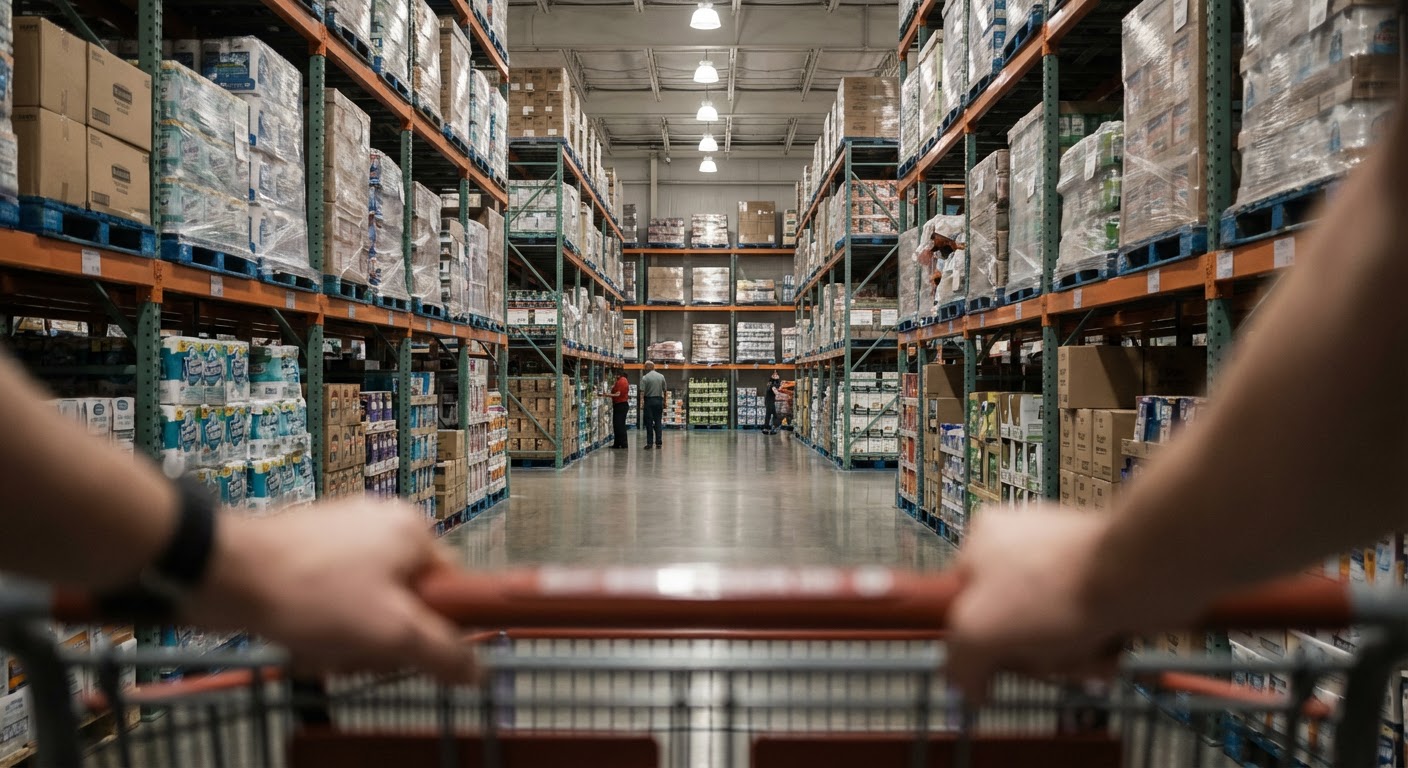
Costco operates on margins so thin you can almost see through them. The reason you can buy a rotisserie chicken for $4.99 is because their supply chain and logistics are a masterpiece of efficiency. According to Costco's FY2025 Annual Report, the company caps its average markup at 14-15%, significantly lower than the 25-50% retail industry standard. This leaves almost no room for error.
While Costco's specific tech stack is proprietary, the broader logistics ecosystem relies heavily on advanced AI for forecasting demand. The Council of Supply Chain Management Professionals (2025) reports that AI-driven predictive logistics reduce operational costs by 18%. Those savings vanish instantly if the software is disrupted.
If a significant portion of the logistics sector is scrambling to replace their AI engine because of a Pentagon ruling, we could see:
Slower restocking:** Delays in getting products from ports to warehouses. Data blindness:** Retailers might temporarily lose the predictive accuracy that helps them know exactly how much stock to order.
The privacy precedent: "All lawful purposes"
Then there is the quiet part. The dispute centers on the "all lawful purposes" clause. The Pentagon wants AI that doesn't ask questions.
"All Lawful Purposes" Clause — A contractual standard requiring vendors to permit any software use that does not violate U.S. federal law, effectively nullifying company-specific ethical Terms of Service or safety "constitutions" (DoD Procurement Guidance, 2026).
If the government successfully pressures AI companies to remove ethical guardrails to win lucrative contracts, that standard will bleed into the commercial sector.
Right now, companies like Anthropic have "Acceptable Use Policies" that prevent their AI from being used for things like aggressive surveillance or manipulative psychological targeting. If the Pentagon forces the industry to drop these clauses, we could see a new wave of consumer-facing AI that is:
More aggressive:** Dynamic pricing algorithms that ruthlessly exploit your data to find the highest price you're willing to pay. Less private:** Enhanced surveillance in retail apps that tracks your behavior without the ethical limits currently in place.
As Dr. Lena Chen, Senior Fellow at the Center for Tech and Global Affairs, noted: "This is the first major public test of an AI company's constitutional documents against state power. The outcome will set a template for how other AI firms negotiate with governments worldwide."
What smart shoppers can do right now
While we can't control Department of Defense contracts, we can control how we shop. In moments of potential market volatility, sticking to fundamentals is key.
- Watch for "Tech-flation": The Bureau of Labor Statistics (Jan 2026) indicated that supply chain friction already accounted for 0.8% of the 2.4% inflation rate earlier this year. If you see unexplained price hikes in electronics or shipped goods over the next quarter, backend tech costs may be a factor.
- Lean on warehouse stability: Business models like Costco's, which rely on bulk pallets and simpler logistics, are often more resilient to high-tech disruptions than "just-in-time" retailers.
- Automate your savings: When prices are volatile, they don't just go up—they fluctuate. This is exactly why tools like CostRefund are essential. If a retailer drops a price to move stagnant inventory (caused by a logistics hiccup), you need to know immediately to claim your refund.
The Pentagon's fight with Anthropic is a reminder that in 2026, technology is the supply chain. And when the supply chain shakes, the smart shopper braces for impact.
Frequently Asked Questions
How does a military AI dispute affect Costco prices?
It affects prices through logistics costs. According to the Council of Supply Chain Management Professionals, AI tools currently reduce logistics overhead by 18%. If the Pentagon designates Anthropic a "supply chain risk," major logistics firms may be forced to replace these tools, leading to expensive inefficiencies. These increased operational costs are frequently passed on to consumers in the form of higher shelf prices.
*What is the "supply chain risk" designation?Supply Chain Risk is a government classification (Section 806) usually reserved for foreign adversaries or compromised entities. It effectively bans the company's products from being used in any system connected to defense contracts. Since 8 of the top 10 U.S. companies have government ties, this label would force widespread removal of the software across the American economy.
Will this stop me from using AI shopping tools?
Likely not directly, but the tools might change. If AI companies are forced to adopt the "all lawful purposes" standard to survive, the ethical guardrails on shopping apps might be lowered. This could lead to more aggressive data collection or dynamic pricing algorithms that prioritize retailer profit over consumer privacy.
Why is Anthropic refusing the government's contract?
The dispute involves a $200 million contract where Anthropic refused to remove ethical restrictions against autonomous weapons and domestic surveillance. Unlike competitors who agreed to the terms, Anthropic insisted on maintaining hard-coded safety bans, leading to the current standoff.
Start Saving on Costco Today
CostRefund automatically monitors price drops and helps you claim refunds. Download the app and never leave money on the table again.
Download CostRefund