
Costco's New Entrance Scanners: The 2026 Data Crackdown You Didn't See Coming

Costco's New Entrance Scanners: The 2026 Data Crackdown You Didn't See Coming
The ritual used to be simple. You walked up to the warehouse entrance, flashed your card at the greeter—a quick "Costco wave"—and you were in. It was a low-tech handshake that worked for decades.
That handshake is gone.
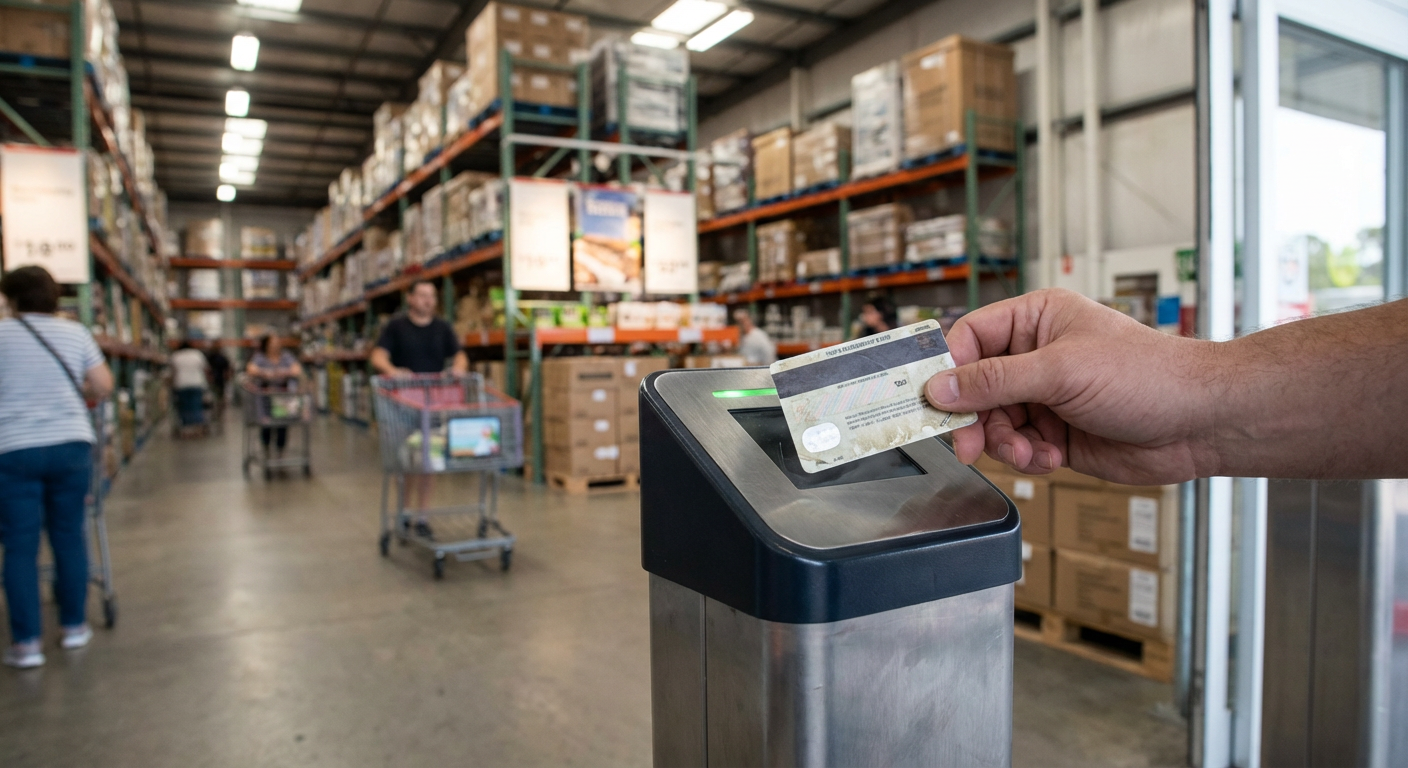
Now, you are funneled toward a glowing pedestal that demands a scan before the plexiglass gates part. It feels less like a grocery run and more like clearing airport security. For longtime members, the shift is jarring. In early 2026, Costco finished installing these scanners at every warehouse nationwide.
On the surface, this is about efficiency. But if you look closer at the operational shift, you realize this isn't just about keeping non-members out of the food court. It is about data.
For the strategic shopper, this technology signals a fundamental change in how the retailer manages its inventory, its returns, and its people. Here is what is actually happening behind the scanners and how to protect your savings in this new environment.
Key Takeaways
Mandatory Scanning:** As of February 2026, the "flash" is dead. Every member must physically scan a card or digital ID to enter. Return Policy Link:** Entry data is now cross-referenced with return history to identify "serial returners" under stricter 2026 protocols. Food Court Access:** Kiosks now require an active membership scan to buy the $1.50 hot dog combo. Non-members are officially shut out. The Smart Shopper Pivot:** Because physical returns are under higher scrutiny, automated price adjustments have become the safest way to reclaim cash without flagging your account.
The End of the "Flash and Go" Era
The old system relied on the honor code. But as membership fee income rose 14% year-over-year in Q1 fiscal 2026, Costco decided the honor code was too expensive to maintain.
The new protocol is binary. You need a valid barcode. If your card has expired, if you borrowed it from your cousin, or if the photo on file doesn't match the face standing at the turnstile, the gate stays closed. Consequently, Digital ID—the QR code in the official app—is now the standard way to enter, mostly because fumbling for a physical card slows down the line.
Ron Vachris, Costco's CEO, argues that scanning at entry leads to a "better member experience and faster registers." The logic is simple: catch the invalid memberships before the cart is full. According to reports from CBS News (2024), this started as a pilot in Washington state before expanding nationwide to protect the membership model, which generates nearly 75% of the company's operating income.
But there is a secondary effect that fewer people talk about. By digitizing entry, Costco creates a timestamped log of your visit. They know when you arrived. They know how long you stayed. And crucially, they know if you scanned in, wandered the aisles for an hour, and left without buying a thing.
The "Return Policy Crackdown" Connection
This is where the math changes for deal hunters. The scanners are not operating in a vacuum; they feed into a broader system that International Business Times Australia described in February 2026 as a "Return Policy Crackdown."
The days of "no questions asked" are fading. According to the National Retail Federation (2025), fraudulent returns cost US retailers approximately $103 billion annually. "Bracket shopping"—buying three versions of an item to return two—is a primary target. Costco is simply no longer willing to absorb that cost.
The entry data builds a profile. If you are flagged as a Serial Returner—defined as a member whose return frequency exceeds 3 standard deviations of the average without corresponding purchase volume—the system now has the data to audit your membership.
We are already seeing the friction. A rule strictly enforced in 2026 requires members to physically bring spoiled food items to the warehouse for refunds. Showing a photo on your phone doesn't work anymore. If you want your money back for that moldy cheese, you have to haul it in.
Why Automated Price Adjustments Matter More Now
This tightening environment forces smart shoppers to pivot.
In the past, if you bought a TV for $1,000 and it dropped to $800 the next week, the "hack" was to buy the new one and return the old one using the old receipt. It was a hassle, but it worked. Under the 2026 protocols, that behavior looks suspicious. Frequent returns of high-value items are exactly what the new algorithm hunts for.
This makes Price Adjustments the superior strategy. A price adjustment is not a return. It is a policy-backed guarantee: if an item drops in price within 30 days, you get the difference back. It keeps the item in your home and, more importantly, it keeps your return history clean.
The catch? Costco does not automate this. You have to catch the price drop yourself. With the crackdown in full swing, using a tool like CostRefund to monitor receipts and alert you to price drops is safer than playing games with the return desk. You get the cash back, but you stay off the radar.
Competitors Are Watching
While Costco adds friction, its competitors are removing it.
Sam's Club has taken a different route. In late 2025, they extended Sunday hours for Plus members (8 a.m. to 8 p.m.) and announced plans to open 15 new clubs annually. Their strategy relies heavily on digital ease. According to their 2025 earnings report, Sam's Club Plus members now generate over 50% of their sales through digital channels or 'Scan & Go,' bypassing checkout lines entirely.
As Chris Nicholas, CEO of Sam's Club, stated in a 2025 press release: "We are removing the friction of the checkout entirely for our digital-first members." It is a fascinating divergence. Costco is betting that its product quality is enough to make you tolerate the checkpoint. Sam's Club is betting that you'll eventually get tired of the queues.
Comparison: The New Warehouse Landscape
| Feature | Old Costco Experience | New 2026 Costco Experience | Sam's Club Strategy |
|---|---|---|---|
| Entry Method | Visual check by greeter | Mandatory digital/card scan | Open entry / App scan |
| Returns Policy | Lenient, photo-based for food | Strict, physical item required | Standard retail policy |
| Checkout Speed | Manual belt loading | Pre-verified at entry to speed up | Scan & Go (No checkout line) |
| Price Drops | Manual monitoring required | Manual monitoring required | Automated for online items |
| Food Court | Open access (lax enforcement) | Members only (Scan required) | Open access (varies by location) |
What This Means for Your Next Trip
The scanners aren't going anywhere. To navigate this new landscape without headaches:
- Download the Digital App: Physical cards wear out and scanners struggle with them. The digital ID in the Costco app works instantly.
- Stop Sharing: If you have been letting a roommate borrow your card, stop. The photo on the scanner screen is large, high-resolution, and facing the attendant. They are checking.
- Audit Your Returns: Be selective about what you physically return. For price drops, always opt for the adjustment instead of the return-rebuy loop.
Costco is still the king of warehouse value—Executive members now account for 47.7% of total paid members and drive nearly 73% of global sales (TradingView 2025). But the relationship is changing. It is becoming more transactional and more data-driven. As a shopper, your strategy needs to evolve with it.
Frequently Asked Questions
1. Can I still use my family member's Costco card at the scanner? No. The system displays the cardholder's photo on a 15-inch screen facing the attendant immediately upon scanning. If you are not the person in the photo, entry is denied. Enforcement has tightened significantly to protect membership fee revenue, which reached $1.17 billion in Q1 2025 alone.
2. Does scanning my card at the entrance affect my ability to return items? Yes. The entrance scan creates a timestamped data point verifying your physical presence. Costco uses this to identify "unusual" patterns—such as a member who returns high-value electronics frequently but rarely scans in for regular grocery trips. This data contributes to the "Serial Returner" profile.
3. Why did Costco install these scanners now? The primary driver is revenue protection and checkout speed. Non-member shopping was estimated to dilute membership value, and CEO Ron Vachris stated that verifying membership at the door "speeds up the register experience" by eliminating invalid cards before the checkout belt.
4. Is there an easier way to get money back if I miss a sale? Yes, request a Price Adjustment instead of returning. Costco offers a 30-day window to refund the difference if a price drops. Since Costco does not automate this, third-party tools or manual tracking are required, but this method protects your account standing better than physical returns.
Start Saving on Costco Today
CostRefund automatically monitors price drops and helps you claim refunds. Download the app and never leave money on the table again.
Download CostRefund